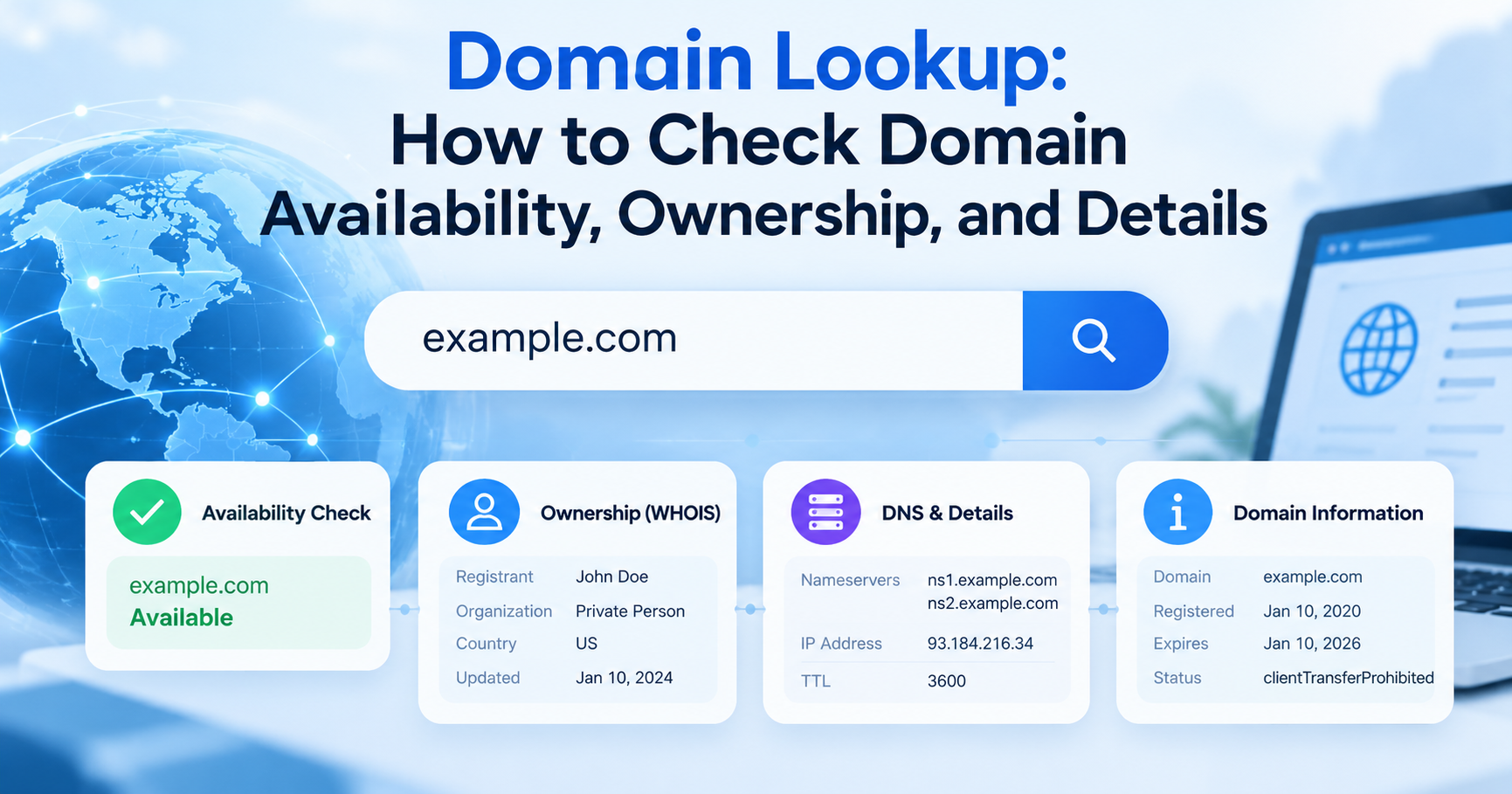
A domain lookup helps you check whether a domain name is available, registered, active, expired, or connected to specific registration records. It is commonly used before buying a domain, researching a website, or troubleshooting DNS and ownership issues.
Table of Contents
ToggleWhat Is a Domain Lookup?
A domain lookup is the process of searching for information about a domain name. Depending on the lookup tool, you can check registration status, registrar details, DNS records, nameservers, expiration dates, and other technical information.
For example, if you search for example.com, a domain lookup can show whether the domain is already registered and which registrar manages it. Some tools can also show DNS information such as A records, MX records, and nameservers.
Why Is Domain Lookup Important?
Domain lookup is useful for website owners, developers, businesses, and SEO professionals. It provides quick information about a domain before you register, purchase, migrate, or troubleshoot it.
Common reasons to perform a domain lookup include:
- Checking whether a domain name is available
- Finding the domain registrar
- Viewing domain registration dates
- Checking domain expiration information
- Identifying nameservers
- Reviewing DNS records
- Investigating domain configuration problems
- Researching a domain before purchasing it
How Does a Domain Lookup Work?
A domain lookup sends a query to domain registration or DNS databases and returns available information about the requested domain. The exact data depends on the lookup method being used.
Traditional WHOIS systems provide registration-related information, while modern RDAP services provide structured domain registration data. DNS lookup tools focus on technical records such as IP addresses, mail servers, and nameservers.
What Information Can You Find With a Domain Lookup?
A domain lookup can reveal several types of information about a website’s domain.
Domain Registration Status
The lookup can show whether a domain is registered or currently available for registration. If the domain is already registered, you may also see its current status codes.
Common domain statuses include:
- Active
- ClientTransferProhibited
- ClientHold
- RedemptionPeriod
- PendingDelete
These statuses can help explain whether a domain can be transferred, renewed, or registered again.
Domain Registrar
The registrar is the company responsible for managing the domain registration. A domain lookup can often identify the registrar even when personal ownership information is hidden.
Knowing the registrar can be useful when troubleshooting transfers, renewals, or domain management issues.
Registration and Expiration Dates
Domain lookup tools may display the original registration date, last update date, and expiration date. These dates help users understand how long a domain has existed and when its registration may need renewal.
Expiration data can also be useful when monitoring domains you may want to acquire in the future.
Nameservers
Nameservers determine where DNS information for a domain is managed. A domain lookup can reveal the nameservers currently assigned to the domain.
For example:
ns1.examplehost.com
ns2.examplehost.com
This information can help identify the DNS provider or hosting infrastructure connected to the domain.
DNS Records
Some domain lookup tools also include DNS lookup functionality. These tools can show records such as:
- A records
- AAAA records
- MX records
- CNAME records
- TXT records
- NS records
- SOA records
DNS records explain how a domain connects to websites, email servers, verification services, and other online systems.
Domain Lookup vs WHOIS Lookup
A domain lookup is a broader term that may include registration, DNS, availability, and technical information. A WHOIS lookup traditionally focuses mainly on domain registration records.
WHOIS databases historically displayed details such as registrant names, addresses, phone numbers, and email addresses. Today, much of this information may be hidden because of privacy protection and data protection policies.
Modern domain lookup services may combine WHOIS, RDAP, DNS, and availability checks into a single interface.
What Is an RDAP Domain Lookup?
RDAP stands for Registration Data Access Protocol. It is a newer protocol designed to provide structured registration information for domains, IP addresses, and internet resources.
RDAP offers several improvements over traditional WHOIS. It uses standardized JSON responses, better access controls, and more consistent formatting across registries.
For developers and automated systems, RDAP is often easier to process than traditional WHOIS output.
How to Check If a Domain Is Available
The simplest domain lookup is an availability check. Enter the domain you want to register, such as:
mynewwebsite.comThe lookup system checks whether the domain currently exists in the relevant registry. If no active registration exists, the domain may be available for registration.
However, availability can change quickly. A domain shown as available should normally be registered as soon as possible if it is important to your project or brand.
How to Choose a Good Domain Name
A good domain name should be simple, memorable, and easy to type. Avoid unnecessarily long names, confusing spellings, and excessive hyphens.
When choosing a domain, consider:
- Brand relevance
- Length
- Spelling
- Domain extension
- Trademark conflicts
- Memorability
- Search intent
- Future business expansion
A strong domain should still make sense if your website grows beyond its original topic.
What Are Domain Extensions?
A domain extension is the final part of a domain name. It is also known as a top-level domain or TLD.
Examples include:
| Domain Extension | Common Use |
|---|---|
.com | Businesses and general websites |
.org | Organizations and communities |
.net | Technology and network-related sites |
.io | Technology and software projects |
.co | Companies and startups |
.pk | Pakistan-focused websites |
.uk | United Kingdom websites |
The extension you choose can affect branding, availability, and geographic targeting.
Can Domain Lookup Show the Website Owner?
Sometimes, but not always. Domain registrant information is frequently hidden behind privacy protection services or restricted because of data protection requirements.
A lookup may still show technical information such as the registrar, registration dates, nameservers, and domain status. Public ownership information depends on the registry, registrar, extension, and applicable privacy policies.
What Is Domain Privacy Protection?
Domain privacy protection hides personal registrant information from public domain registration databases. It is commonly used to reduce spam, unwanted contact, and exposure of personal information.
Instead of showing the registrant’s direct contact details, the lookup may display privacy-protected information or limited registration data.
Privacy protection does not make the domain anonymous to the registrar or relevant authorities. It primarily limits what is publicly visible.
How Domain Lookup Helps With Website Troubleshooting
Domain lookup tools are useful when diagnosing website and DNS problems. They can help determine whether a domain is active and whether its nameservers or DNS records are configured correctly.
For example, if a website stops loading after a hosting migration, checking the nameservers can confirm whether the domain is pointing to the new DNS provider. An A record lookup can then verify whether the domain resolves to the correct server IP address.
Domain Lookup for Email Troubleshooting
Domain lookup can also help diagnose email delivery problems. MX records identify the mail servers responsible for receiving email for a domain.
TXT records may contain SPF, DKIM-related information, verification tokens, or other email authentication settings. Checking these records can help identify configuration problems that affect email delivery.
Domain Lookup for SEO Research
Domain lookup provides useful technical context during SEO research. It can help confirm whether a domain is active, how its DNS is configured, and whether it has recently changed infrastructure.
However, registration age alone should not be treated as a direct indicator of website quality or ranking potential. SEO performance depends on many factors, including content quality, backlinks, crawlability, technical health, relevance, and user experience.
Domain Lookup Before Buying an Existing Domain
Before purchasing an existing domain, basic domain lookup should be part of your research. Check the registration status, registrar, DNS configuration, and expiration information.
You should also investigate the domain’s history before completing a purchase. A domain may have previously been used for spam, unrelated content, redirects, or low-quality websites.
Domain ownership information alone is not enough to determine whether a domain is a good investment.
Domain Lookup and Domain Expiration
An expired domain does not always become immediately available for registration. Domains can pass through several stages after expiration.
Depending on the extension and registrar, the process may include:
- Expiration
- Renewal grace period
- Redemption period
- Pending deletion
- Release for registration
The exact process varies between domain registries and extensions.
Domain Lookup vs DNS Lookup
Domain lookup and DNS lookup are related but not identical.
| Domain Lookup | DNS Lookup |
|---|---|
| Checks registration information | Checks DNS configuration |
| Can show registrar details | Can show IP addresses |
| May show expiration dates | Shows A, MX, TXT, NS, and other records |
| Can check domain availability | Helps diagnose DNS problems |
| May use WHOIS or RDAP | Queries DNS servers |
A complete domain research tool may provide both functions.
Is Domain Lookup Free?
Most basic domain lookup services are free. Users can usually check domain availability, registration status, nameservers, and public registration data without paying.
More advanced services may charge for historical WHOIS data, bulk domain research, monitoring, API access, or large-scale DNS analysis.
Is Domain Lookup Accurate?
Domain lookup information is generally reliable when it comes directly from registries, registrars, RDAP servers, or authoritative DNS servers. However, cached information may sometimes be outdated for a short period after changes.
For example, DNS records can continue showing older values until their cache expires. Registration changes may also take time to appear across third-party lookup services.
Final Thoughts
A domain lookup is one of the fastest ways to understand the status and technical configuration of a domain name. It can help you check availability, identify registrars, inspect nameservers, review DNS records, and troubleshoot website or email problems.
Whether you are registering a new domain, managing an existing website, or researching a domain before purchase, checking its registration and DNS information gives you a clearer picture of how the domain is configured and managed.